
One of the most underappreciated truths in strokecare is also one of the most consequential: the most important decisions are made before certainty exists.
A recent paper in Communications Biology illustrates this clearly. Using deep generative models, the authors show that routine #CT #angiography — already standard in #hyperacute #stroke workflows — can be transformed into computed perfusion maps that infer functional brain vulnerability before permanent tissue injury is established.
What’s notable is not just the modeling approach, but the design philosophy. The work relies on imaging that is already widely deployed, fits into existing clinical workflows, and operates within the narrow time window where decisions about intervention actually matter. Rather than chasing perfect information, it focuses on extracting useful signal from data we already have.
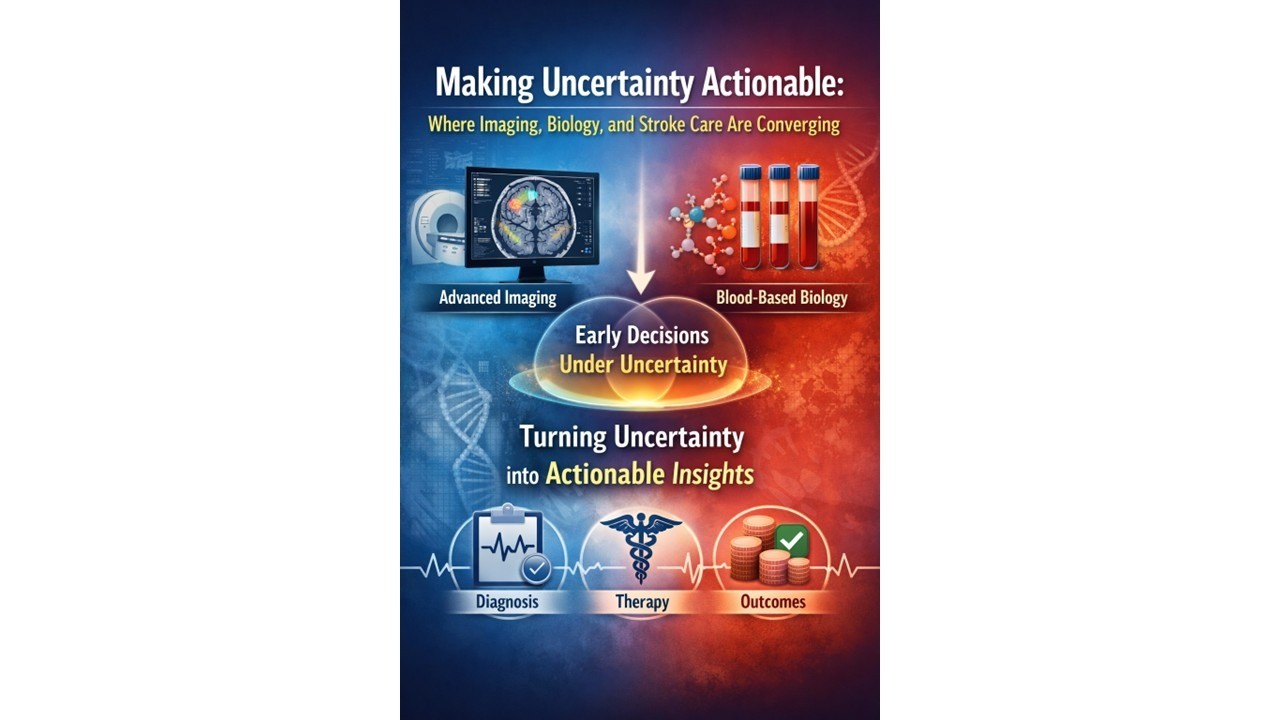
Advanced imaging and blood-based biology are converging on the same truth: early stroke decisions must be made under uncertainty, and the job of precision medicine is to make that uncertainty actionable.
Historically, stroke diagnostics have been optimized for confirmation: Where is the lesion? What territory is involved? What damage is already done?
But confirmation comes late.
The harder — and more impactful — questions live upstream:
- What mechanism caused the event?
- Which patients are at highest risk of recurrence?
- Which interventions are most likely to change outcomes?
Imaging-based approaches like this recent work are beginning to answer where and how severely the brain is threatened, earlier in the care pathway. In parallel, blood-based approaches are increasingly capable of revealing why the event occurred — exposing systemic, immune, and vascular biology that imaging alone cannot resolve.
These are not competing paradigms. They are complementary layers of the same problem.
Imaging provides spatial and functional context. Biology provides mechanistic insight and forward-looking risk.
Neither is sufficient in isolation. Together, they create the possibility of decision support that is earlier, more nuanced, and more aligned with how clinicians actually practice.
This convergence matters not just for stroke, but for how we think about precision medicine more broadly. The future will not be built on single modalities or perfect datasets, but on integrating imperfect signals in ways that respect clinical workflow, regulatory reality, and economic constraints.
The opportunity ahead is not to eliminate uncertainty — but to characterize it well enough that better decisions can be made when timing matters most.
Tangwiriyasakul, C., Borges, P., Pombo, G. et al. Deep generative computed perfusion-deficit mapping of ischaemic stroke. Commun Biol (2026). https://doi.org/10.1038/s42003-025-09495-6
